

Every day, in thousands of companies, management makes strategic decisions on unstable foundations.
Not for lack of data. Quite the opposite: the data is there, often in abundance. The problem is that it is scattered. It lives in different ERPs, parallel Excel sheets, reports that don’t talk to each other. When the time comes to decide, the picture is never truly complete. This article analyses the three concrete problems holding back companies’ decision-making capability today and explains why decision intelligence is the answer the market has been waiting for.
The problem isn’t the data. It’s its fragmentation.
Modern companies don’t suffer from a scarcity of data. They suffer from an excess of noise.
ERP, CRM, cloud platforms, analytics tools: each system produces information independently, with its own logic, its own formats, its own update cycles. The result is an ecosystem of disconnected data that doesn’t generate vision, it generates confusion.
When systems don’t talk to each other, management pays the price
The CFO who asks for a liquidity forecast has to wait for someone to extract data from three different sources, cross-check it manually and produce a report. In the meantime, the decision window has already closed.
It is not a question of competence. It is a structural problem: the information exists, but it isn’t accessible in an integrated, reliable way when it’s needed.
The real cost of inconsistent data

According to industry estimates, up to 25% of company data may contain undetected errors or inconsistencies. These are not rare anomalies: it is the normal condition of anyone working with non-integrated systems.
Every undetected inconsistency is a hidden risk. Every decision made on impure data is a decision exposed to misjudgements, late corrections and costs that only surface when it’s too late to intervene effectively.
Manual reconciliations consume the time that should go to strategy
There is a silent paradox in highly complex organisations: the most qualified professionals controllers, CFOs, senior analysts spend a significant part of their time checking, cross-referencing, reconciling.
Not planning. Not interpreting. Cleaning.
The closing cycle as a mirror of inefficiency
The accounting close is where this problem is most concentrated. Every month-end, the same manual tasks, the same bottlenecks, the same operational pressure.
When the close takes days of checks, management receives information late. It decides under uncertainty or worse, decides in advance on projections that don’t reflect the updated reality.
The domino effect on decision-making
A slow closing cycle is not just an operational problem. It is a strategic one.
The delay spreads: it slows analysis, compresses planning time, creates strain. Resources that could be working on strategy are absorbed by managing emergencies. Vision narrows. Decisions become reactive instead of proactive.
Deciding under uncertainty: the risk that never gets accounted for
There is a cost that doesn’t appear in any financial statement, but that every organisation pays regularly: the cost of decisions made with information that is incomplete, unvalidated or late.
It isn’t easy to measure. But it shows in the results: missed opportunities, unanticipated risks, course corrections always made in a rush.
The difference between having data and having vision
Having access to data is not the same as having vision. Vision requires data that is integrated, validated and contextualised and the ability to turn it into clear operational guidance.
A traditional Business Intelligence platform shows the data. It doesn’t interpret it. It doesn’t connect it to decision workflows. It doesn’t generate explainable insights. It represents the situation but doesn’t help govern it.
When AI replaces noise with clarity
Decision intelligence sits exactly here: in the critical gap between raw data and an informed decision.
This is not automation for its own sake. It is a cognitive layer that filters, validates, interprets and gives management what it really needs: direction. Not one more chart, but a clear answer to a precise question.
See how it works
What Pyxed is and how it solves these three problems
Pyxed was born within the NIXINN ecosystem with a precise mission: reduce operational time and increase the reliability of financial decisions.
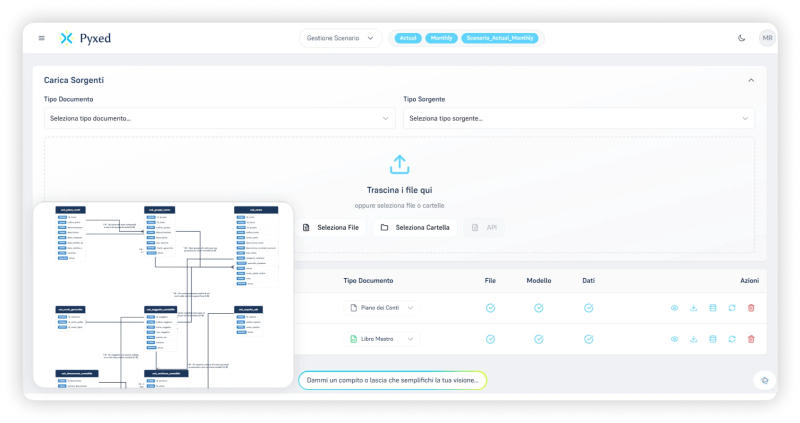
It is not a visualisation application. It is a decision intelligence system that integrates data from ERP, CRM, cloud platforms and analytics tools, validates it automatically and turns it into actionable, traceable insights, compliant with the GDPR and the AI Act.

Integration without disrupting what’s already there
Pyxed works as a decision layer on top of the systems already in use. It doesn’t require replacing the ERP, migrating data or redesigning the technology architecture.
Integration is gradual and non-invasive. You can start from a specific use case the accounting close, liquidity monitoring, validation of financial statement data and scale up progressively, always keeping the return on investment under control.
Hybrid AI: artificial intelligence that amplifies human judgement
Pyxed’s founding principle is clear: AI doesn’t replace human judgement. It amplifies it.
Every output is phrased in natural language, explainable and verifiable. Every insight comes with an audit trail. Human oversight is an integral part of the architecture not an afterthought.
Pyxed doesn’t tell you what to do. It teaches you to see better.

Pure Visioning — from complexity to direction
Pyxed’s tagline is Pure Visioning: pure, lucid, continuous vision.
Not a static forecast, but an active process of interpretation. A system that filters information noise and returns clarity with the same precision with which a constellation guides a navigator on the open sea.

Why decision intelligence is the next frontier of financial management
Business Intelligence taught organisations to read data. Decision intelligence is teaching them to use it.
The shift is not trivial. It requires a paradigm change: stop seeing data as an object of reporting and start treating it as raw material for strategy.
NIXINN’s role in the decision ecosystem
NIXINN was founded on twenty years of experience in business management and control. It is not a software house that added an AI feature to its product. It is an applied innovation lab that integrates artificial intelligence, data analysis and human decision behaviour into business processes.
One principle guides every solution: Data clarity drives strategic clarity.
Clarity in data generates clarity in strategy. It’s not a slogan — it’s the operational result of an approach that puts management at the centre, not technology.
From consulting to product: a coherent ecosystem
Pyxed is the natural evolution of NIXINN’s consulting: from data to insight, from calculation to understanding.
Companies that work with NIXINN don’t receive software to implement on their own. They receive a guided path from assessing the context, to gradual activation, to continuous optimisation. A model that reduces project risk and maximises value over time.
Contact us for a tailored consultation and find out how we can help you take the first step towards your company’s growth.
Conclusion
Fragmented data is not a technical problem. It is a strategic problem.
Every day spent reconciling is a day taken away from planning. Every decision made on uncertain foundations is a risk exposure that never gets accounted for until it surfaces.
Decision intelligence is not the future of financial management. It is already the present. And Pyxed is the tool NIXINN has built to make it accessible, traceable and truly effective.
Complexity won’t disappear. But it can be turned into vision.


